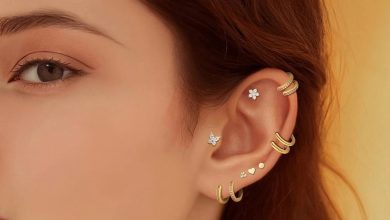

Flat Back Earrings: Comfort, Materials, Sizing & Wear

Introduction
If your earrings stab you when you sleep, catch your hair, or leave your ears sore by evening: flat back earrings are the fix. They’re designed for real life (sleeping, showering, layering, living), not just special occasions.
Traditional butterfly-back studs protrude from your ear, which means they poke, snag, and dig in when you’re lying on your side. Flat backs sit flush against the skin instead. The backing is smooth, solid, and stays put: no poking, no catch, no discomfort. If you’ve ever wondered whether jewelry can actually be comfortable, flat backs are the answer.
Whether you are upgrading your lobe jewelry or hunting for the perfect flat back cartilage earring, this guide walks you through what they are, why they’ve become essential for anyone who wants 14k gold jewelry that doesn’t compromise, and exactly how to choose and wear them.
What Are Flat Back Earrings: And Why They’re Actually Comfortable
Flat back earrings are comfortable because they sit flush against your ear instead of protruding backward, which eliminates the poke, the catch, and the pressure sore. Here’s what that looks like mechanically.
Instead of a curved butterfly clasp, they have a smooth, solid gold backing that sits directly against the skin. The flat back itself never pokes, never snags, never digs in when you’re lying on your side.
This design shift changes everything. You can sleep in them. You can wear headphones. You can layer multiple pieces on the same ear without them competing for space. And because the flat back is internal and threaded, the setup is surprisingly simple, although the technical mechanics deserve a quick explanation.
The most important thing to know about flat back earrings is the insertion method. You insert the flat back first, from behind the ear. The smooth backing goes through your piercing first, and the front post threads into it from the front. This order matters because it means the threaded portion, the part that does the securing, never touches your piercing or ear tissue. It’s a design detail that combines safety with precision fit.
Are Flat Back Earrings Better for Sensitive Ears?
For sensitive piercings, material matters more than design. Solid 14K gold alloyed without nickel is safe for sensitive piercings and suitable for fresh piercings from day one.
Here’s why: many jewelry brands plate cheap metals (nickel-based alloys, brass) with a thin layer of gold or silver. When the plating wears off (which it does, especially if you wear them daily), the base metal underneath irritates your skin. Nickel exposure causes that green discoloration around your piercing and the inflammation that follows. It’s not a flaw in your body; it’s a material failure.
These fine jewelry flat backs are made from solid 14K gold with a nickel-free alloy, by design. There’s no cheap base metal. There’s no plating to wear through. Just gold doing what gold does: staying safe against your skin, year after year.
This distinction matters for fresh piercings especially. Solid gold + nickel-free composition means nothing in the metal works against your healing. You can get pierced with flat backs and heal in them, rather than waiting until they’re fully healed to switch. That’s confidence rooted in material integrity, not a marketing claim.
What Size Flat Back Earrings Should I Buy?
Post length determines whether the earring sits comfortably in your piercing, and this collection offers four discrete sizes to match your anatomy.
A 5mm post is ideal if you need a flat back cartilage earring for tight piercings like the forward helix and helix. 6.5mm is the universal all-rounder that fits nearly every location (forward helix, helix, rook, tragus, conch, daith, lobe). 8mm is for standard lobes and fresh piercings that might swell. 10mm handles deeper-set lobes and larger anatomy.
If you’re unsure, start with 6.5mm; it works across virtually every piercing location. A professional piercer can confirm your exact size in seconds, or you can use the at-home marker method: insert a standard earring you already own, have a friend mark where the post exits the back of your piercing, measure from the base of the front to the mark, and size up one increment for a snug fit.
The front setting size is a separate choice. 2–4mm works beautifully in curated stacks and minimalist looks. 5mm+ makes a statement on main lobe piercings. It’s entirely about which size speaks to your style.
Threading Systems & How to Size Your Fit
Flat back earrings come in three main threading systems: internally threaded (the modern standard, with threading hidden inside the backing), threadless or push-fit (secured by tension, no twisting required), and screw-back (manually twisted to lock). Each has different ease-of-use and durability profiles. Here’s how they differ.
Internally threaded earrings have the threading hidden inside the backing. You thread the front post into the back, and once it’s fully in, the mechanism locks securely. This is the standard for fine jewelry because it’s durable and beautiful: no exposed threading to catch light or cause irritation. Best suited for anyone seeking a secure, elegant setup with hidden mechanics. It’s the fine jewelry standard for a reason.
Threadless earrings (also called push-fit) use tension. The front post is slightly thicker than the hole in the backing, so it stays in place by friction. No twisting required. This is incredibly convenient for those who dislike threading mechanisms. Ideal for anyone who values quick insertion and removal, but best for lighter wear or those who don’t mind occasional re-seating when friction eases.
Screw-back earrings twist to secure. They’re less common for studs, but some customers prefer the reassurance of an explicit lock mechanism. A natural fit for anyone who wants the confidence of a manual lock that won’t loosen accidentally.
For most people, internally threaded flat backs are the sweet spot: secure, elegant, and straightforward to use.
Can You Sleep in Flat Back Earrings?
Yes. Sleep in them. Shower in them. Swim in them. Wear them to the gym, to bed, to work, and repeat. Solid 14K gold doesn’t tarnish, doesn’t react with chlorine, and doesn’t require “removal before” warnings. The design is built for daily wear, the kind of wear that builds a relationship with a piece over months and years, not the wear you save for special occasions.
Threading care is simple: thread the front post all the way in until it stops, and give the back a gentle turn every few days to confirm it’s still secure. This isn’t a repair step; it’s a small ritual that keeps the mechanism locked over time. Premium flat backs are engineered to stay put through normal wear (sleeping, moving, everyday life), but the threaded system can gradually ease open over weeks of continuous wear. A quick two-second check every few days is all it takes to maintain that security indefinitely.
Think of it as the small ritual that keeps them in your ear for years. Thread it all the way in, give it a gentle turn every few days, and it’ll stay where you put it. Not a flaw in the product; part of how precision engineering works in real life.
FAQ: Your Flat Back Questions Answered
What if I’m not sure about the right size?
Start with 6.5mm if you’re uncertain. It works across virtually every piercing location, and if it turns out you need a different length, a professional piercer can verify in seconds.
Do flat back earrings require special care or maintenance?
No special care needed beyond the two-second threading check every few days. That ritual keeps them secure through years of sleep, showers, and everyday wear. No “remove before” rules: just a small habit that works.
Can you get pierced with these flat backs?
Yes. Solid 14K gold with a nickel-free alloy is safe for fresh piercings from day one. You can get pierced with flat backs and heal in them: the material supports faster healing because nothing in the composition works against it.
The Takeaway
Flat back earrings aren’t just a comfort upgrade: they’re a philosophy. Jewelry that works for your life, not the other way around.
Whether you’re building your first stack or adding to an existing collection, start with one piece that speaks to you. You’ll be surprised how quickly it becomes non-negotiable.